Blandy Cowl Week 4/4
I'm excited to say that our final installment in the Blandy Cowl Knit-Along series talks about moths -- just in time to put us in the mood for "spooky season"!
Knitters often have a deep loathing or fear of moths because of clothes moths' propensity to eat wool and their ability to destroy an entire yarn stash if left undeterred. The moths we're talking about today aren't scary because of their taste for wool; rather, they are fearsome because of their ability to devour an entire woodland in a generation.
Scientists have been working for over 100 years to mitigate the effects of spongy moths in North America, and while some measures have been effective in the past, work is still being done to preserve our forests into the future.
The Scientist
This week's researcher is Will Loner, a PhD Candidate at UVA whose studies revolve around the spongy moth. Unlike our previous presenters, Will's work doesn't celebrate a native species; rather, he is researching the way an invasive species affects the health of forests and how its spread can be controlled long-term in the face of climate change. You can watch his presentation to the knit-along group here.
The Moth
The spongy moth goes by several names. I was introduced to these moths as "gypsy moths," which is problematic nomenclature for obvious reasons. The Latin name, Lymantria dispar, translates to "The Disparate Destroyer," which is significantly cooler. But in most contemporary US contexts, they are now referred to as "spongy moth," adapted from the French -- we'll see why in a minute.
The spongy moth is sexually dimorphous, meaning that the males and females have different physical characteristics. In this case, the males and females look so unrelated, they were once thought to be two different species.
The males go through five life stages, culminating as woodsy black and brown moths, like the one below:
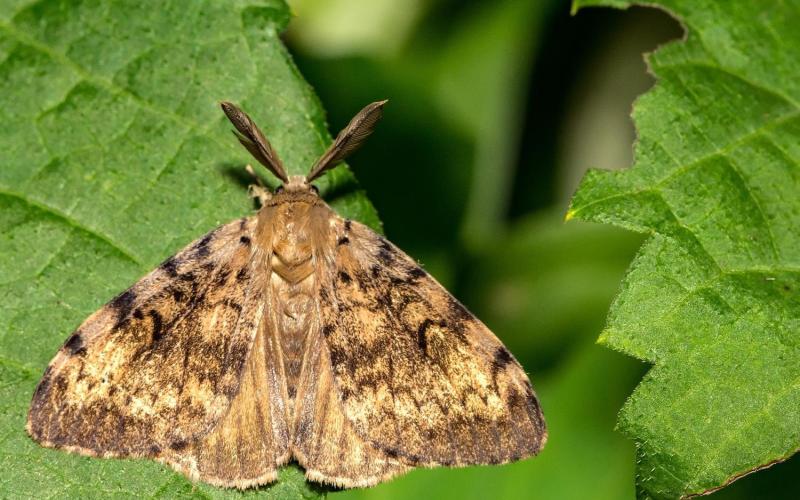 |
| Photo available through Minnesota Department of Agriculture |
The female spongy moths go through six life stages, evolving into flightless white moths that bear an uncanny resemblance to a certain Narnian witch:
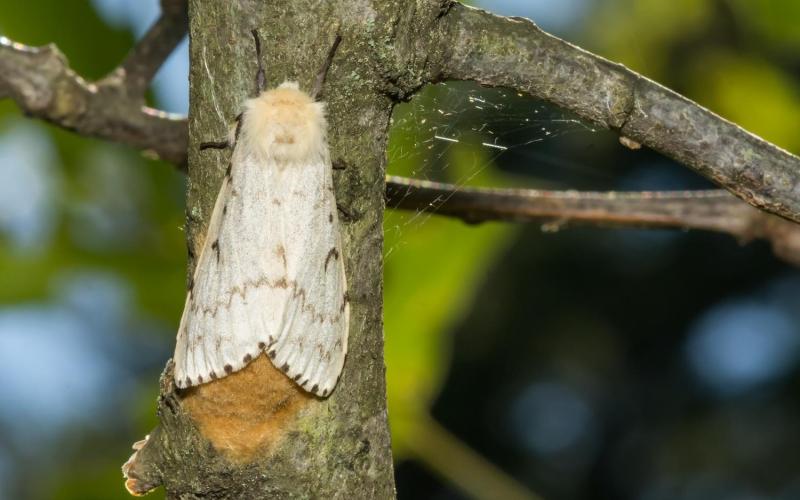 |
| Photo available through Minnesota Department of Agriculture |
As caterpillars, spongy moths have distinctive red and blue spots on their backs, and they are covered in spines that are known to irritate human skin.
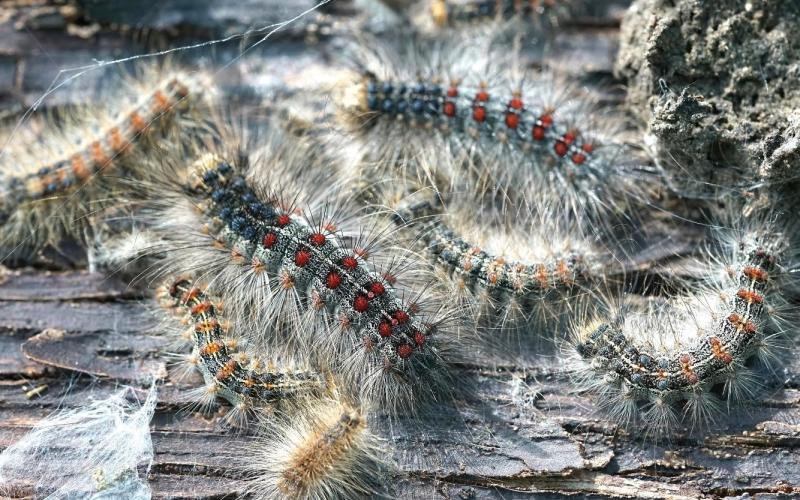 |
| Photo available through Minnesota Department of Agriculture |
The moths are what biologists call "generalists," meaning they have many food sources rather than an exclusive host species. Here in Virginia, spongy moths are most commonly found on oaks, as those are the dominant tree in our landscape, but spongy moths are known to eat over 150 different North American plants.
The American Integration
Last week, we talked about the merits of assisted migration and how purposeful introduction of species to areas outside their current range can help them survive in a changing climate. This week, we see the destruction that can happen when humans think they know better than Mother Nature.
In the late 1860s, after the Civil War ravaged the US and the textile industry faced the reality that growing cotton for quick cash wasn't nearly as profitable if you actually paid the people working the fields, a French gentleman living in New England believed he had found the solution: silk.
Etienne L. Trouvelot began importing silk moths from Asia to his home in Bedford, Massachusetts. The silk moths weren't problematic to the US landscape, as centuries of breeding in captivity meant they were no longer suited to life in the wild. Trouvelot went a step further, though. He decided it would be a marvelous idea to raise moths from his French homeland here in the States.
This was not a marvelous idea.
In a completely random turn of events that no one could have possibly seen coming, some of the moths escaped the care of Trouvelot and made their way into the surrounding woods, where they proceeded to happily decimate the forest.
Remediation
By 1905, the spongy moths had torn through enough of the New England canopy that the US Forest Service intervened. According to Will, this began "one of the largest efforts to find a biological control agent ever undertaken by the US government."
Foresters were able to identify 34 species capable of either eating spongy moths or parasitizing them. Of the 34 species identified, 12 were able to sustain themselves in North America, including parasitic tachinid flies.
Again, we experienced a totally unforeseen turn of events: the flies were also generalists. In addition to devouring spongy moth larvae, the flies nearly eliminated the brown tail moth population and have contributed to decreasing numbers of American silk moths, like the luna moth.
Other remediation methods were more successful and continue to be used today.
The nuclear polyhedrosis virus combats spongy moth populations by inducing a state of "zombification" in larvae. The virus causes spongy moth caterpillars to climb to the tops of trees, where they eventually burst, showering the nearby area with the pathogen. While incredibly effective, because of the pathogen's radial spread, it is considered "density dependent," contributing to cyclical booms and crashes in spongy moth populations.
The most effective remediation method to date was discovered by accident. In 1989, the entomophaga maimaiga fungus native to Japan appeared in New England. In the decades since its discovery, the fungus has kept most spongy moth populations in the Northeast US below outbreak status. However, the fungus prefers cool, dry conditions -- conditions that are decreasing as North America faces longer periods of drought and increased aridification.
Next Steps
The spongy moths remain on the top 100 list of most destructive invasive species. While researchers like Will are working to find long-term solutions to keep the spongy moth population manageable, there are a few things we can do in our own backyards to help slow the spread.
The female spongy moths lay their eggs on tree trunks in August, leaving fuzzy white blobs about the size of a quarter. The eggs don't hatch until April, allowing people several months to spot the egg sacs and scrape them off the affected trees.
Should you notice defoliation in your yard, Will recommends contacting an arborist. If the defoliation is caused by spongy moths, the arborist can place a specialized trap that releases the nuclear polyhedrosis pathogen to curb a local emergence.
The Cowl
The female spongy moth appears on our cowl, along with the other species we learned about. In this picture, the leaves vining up from the bottom edge belong to a black tupelo tree, and in the bottom right corner, we have our spongy moth:

Moving around the cowl, we have a chimney bee:

Finally, have woodcock with a butternut tree branch overhead, plus a pair of "white walnuts":

Because I was working with Universal Yarns Bamboo Pop yarn, a blend of cotton and bamboo viscose, I ended up with a very soft, slouchy cowl. If you're making a cowl of your own, I would suggest choosing a fiber that's less likely to collapse under its own weight so that you can properly show off your handiwork.

The pattern for this cowl is available for free. For more insect-inspired designs, be sure to check out LeafHopperKnits.
I have thoroughly enjoyed using knitting as a medium to learn more about science and my local ecosystem. If you have any patterns or resources in a similar vein, please recommend them to me!


Comments
Post a Comment